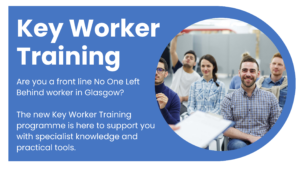
The programme aims to build specialist skills, strengthen service delivery and create a more inclusive employment landscape for disabled job seekers.
We are working with Glasgow City Council to provide fully funded training to Key Workers in the city.
Who is it for?
Anyone working as part of Glasgow Futures No One Left Behind programme – whether that’s with a focus on employability, child poverty or social care.
Why take part?
You can access expert led training with lived experience insights to enhance your ability to support disabled job seekers and clients, and create stronger employer engagement.
We are running a number of fully funded online training sessions throughout 2025 and early 2026.
Training Sessions
If you work for Glasgow City Council or for an organisation delivering Glasgow’s No One Left Behind service, you can register for our fully funded online training sessions. We are planning more dates and will add them here soon!
Neuro-Inclusive Workplace Bitesize – Tues 13th Jan (1.30-2.30pm)
An insightful and practical session designed to deepen your understanding of neurodiversity and neurodivergence.
In this workshop, you’ll explore, in a bitesize format:
- What is Neurodiversity and Neurodivergence? Learn the key definitions and why they matter.
- Common Neurodivergences: From ADHD and autism to dyslexia and beyond.
- Lived Experiences: What do neurodivergent individuals encounter in workplace settings?
- Creating Inclusive Work Environments: Practical strategies to make workplaces more neurodiversity-friendly.
- Retention and Career Progression: Supporting neurodivergent employees to thrive long-term.
- Resources and Support: Tools, networks and best practices.
Reasonable Adjustments and Access to Work – Mon 19th Jan (10-11.30am)
This course offers the opportunity to build knowledge and skills around supporting people with a range of disabilities by focusing on the benefits of Reasonable Adjustments in the workplace and navigating Access to Work applications.
Accessibility Awareness Training – Wed 21st Jan (9.30-11.30am)
This is a 2 hour tutor led course offering a look at general accessibility awareness for the production of digital information. It will look at different disabilities and the issues they might have accessing digital information and the strategies that could be used to make the information more accessible. It is designed for people producing digital content for website, social media and documents.
The course looks at:
- Why it is important for your online content to be accessible
- Accessibility for people with sensory disabilities
- Accessibility for people with physical disabilities
- Accessibility for people with learning disabilities
- Accessibility for people with cognitive disabilities and learning difficulties
- The WCAG (Web Content Accessibility Guidelines) 4 stage model for ensuring your information is as accessible as possible
Introduction to Sensory Awareness – Tues 27th Jan (2-3.30pm)
This session will begin with improving Deaf Awareness including Deaf Culture, BSL, Hearing Loss, Communication. We will also explore the impact of Sight Loss and Blindness, the challenges, and the opportunities. This session will have practical discussions, various Q+A opportunities and breakout rooms.
How to be a Confident Service Provider – Thurs 29th Jan (9.30-11am)
Gain an understanding of your legal responsibilities and how to confidently support people with vision impairments as a service provider or employer.
Neuro-Inclusive Workplaces Bitesize – Thurs 12th Feb (1.30-2.30pm)
An insightful and practical session designed to deepen your understanding of neurodiversity and neurodivergence.
In this workshop, you’ll explore, in a bitesize format:
- What is Neurodiversity and Neurodivergence? Learn the key definitions and why they matter.
- Common Neurodivergences: From ADHD and autism to dyslexia and beyond.
- Lived Experiences: What do neurodivergent individuals encounter in workplace settings?
- Creating Inclusive Work Environments: Practical strategies to make workplaces more neurodiversity-friendly.
- Retention and Career Progression: Supporting neurodivergent employees to thrive long-term.
- Resources and Support: Tools, networks and best practices.
Mental Health and Wellbeing Support for Job Seekers – Tues 17th Feb (10-11.30am)
This 90 minute online workshop will provide an awareness around some of the most common mental health challenges that jobseekers may be experiencing including depression and anxiety.
We will also explore the following:
- How mental illness’s impact motivation and ability.
- How the routine of work can benefit good mental wellbeing.
- We will discuss effective ways to provide relevant support to help enable a return to work plus resources and self-help strategies to manage setbacks.
What is Learning Disability Awareness? Wed 25th Feb (10am-12pm)
you will learn practical ways to better support people with learning disabilities in everyday settings. The training combines staff awareness with concrete strategies for creating supportive working environments, delivered through an interactive workshop with plenty of time for questions and discussion.
By the end, you will feel more confident supporting someone with a learning disability at home, at work, and in the wider community.
This course is co-designed and co-delivered with a person who has a learning disability, ensuring lived experience is at the heart of the learning.
What is Learning Disability Awareness? Mon 2nd March (10am-12pm)
you will learn practical ways to better support people with learning disabilities in everyday settings. The training combines staff awareness with concrete strategies for creating supportive working environments, delivered through an interactive workshop with plenty of time for questions and discussion.
By the end, you will feel more confident supporting someone with a learning disability at home, at work, and in the wider community.
This course is co-designed and co-delivered with a person who has a learning disability, ensuring lived experience is at the heart of the learning.
The Details
Before registering, please read the course content to ensure it meets your training needs. Our training sessions run as interactive sessions; discussion and participation is involved (you can participate at a rate you are comfortable with). Therefore we have limited spaces available.
If, for any reason, you can no longer attend the training session, please inform us at info@susescotland.scot as soon as possible so we can fill the space from our waiting list.
You can also substitute your place with a colleague. In this case please send their details, including their name and email address, to info@susescotland.scot.
Training sessions are not recorded.
We aim to ensure our courses are as accessible as is reasonably possible. Please let us know of any specific needs you have or if there is anything we can do to make things more accessible for you, such as dial-in access, or if you prefer to interact via the chat function. Please add your request or information to the Accessible Communication section of the registration form.
The information you provide when booking is stored to allow us to manage your booking. Please read our Privacy Policy.
Lived Experience Consultants
We’re growing our Experience Network! This is a group of people who have lived experience of a disability or long-term health condition who work with us to deliver projects, training and consultation. Find out more about joining the Experience Network.